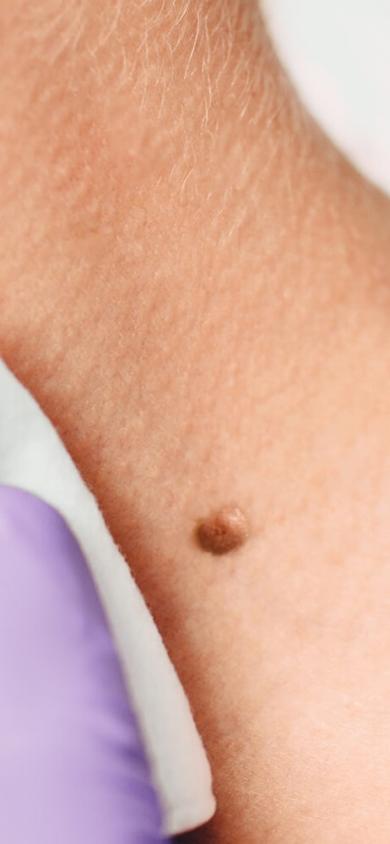
Due to UV exposure in particular, skin tumors occur more frequently in the facial area. Different types of skin cancer can be distinguished here. Common types of cancer are “white skin cancer”, which emerges from the skin epithelium, and malignant melanoma (“black skin cancer”).
The "white skin cancer" is further divided into the basal cell carcinoma (synonym: basalioma) and spinocellular carcinoma (synonym: spinalioma). Often are the so-called sun terraces of the face affected (especially the nose and ears). Basal cell carcinoma is characterized by locally destructive growth without metastasis in the lymph nodes and therefore local therapy is usually sufficient. In spinocellular carcinoma, it can spread to the lymph nodes of the neck and parotid gland (and rarely other organs). In the case of advanced diseases, it is therefore necessary to remove the local lymph nodes, possibly in combination with the removal of the parotid gland.
In the treatment of malignant melanoma we work closely with our dermatology clinic. The malignant melanoma starts from the pigment-forming cells. Malignant melanomas lead to colonization in the local lymph nodes at an early stage and to other organs of the body in advanced stages. In addition to the removal of the local tumor and examination of the so-called sentinel lymph node, subsequent treatment (e.g. by drug tumor therapy or radiation) is often necessary. In recent years, the prognosis has been significantly improved even in advanced stages thanks to modern immunotherapy.
In the case of all skin tumors, the therapy in the early stage is well tolerated and therefore conspicuous skin changes should be clarified at an early stage. Despite intensive efforts to optimize conservative therapy options, surgical removal is an integral part of the therapeutic concept. In the case of advanced tumors, the tumor must be safely removed, but the function and aesthetics must be preserved or restored. As experienced tumor surgeons, we offer the complete spectrum of tumor surgery including plastic-reconstructive restoration. We discuss the therapeutic concept in our interdisciplinary tumor board. Depending on the respective tumor stage, supportive radiation and radiation chemotherapeutic concepts as well as drug tumor therapy including immunotherapy are available in our tumor center.
Weißer Hautkrebs
Der „weiße Hautkrebs“ wird weiter in die Basalzellkarzinome (Synonym: Basaliome) und spinozellulären Karzinome (Synonym: Spinaliome) unterteilt. Oft sind die sogenannten Sonnenterassen des Gesichtes betroffen (v. a. Nase und Ohren). Das Basalzellkarzinom ist dabei durch ein lokal destruktives Wachstum ohne Metastasierung in die Lymphknoten gekennzeichnet und daher ist die lokale Therapie in der Regel ausreichend. Beim spinozellulären Karzinom kann eine Absiedelung in die Lymphknoten des Halses und der Ohrspeicheldrüse (und selten in andere Organe) auftreten. Bei fortgeschrittenen Erkrankungen ist daher auch die Entfernung der örtlichen Lymphknoten, ggf. auch in Kombination mit der Entfernung der Ohrspeicheldrüse notwendig.
Malignes Melanom
Beim malignen Melanom arbeiten wir eng mit unserer Hautklinik zusammen. Das maligne Melanom geht von den pigmentbildenden Zellen aus. Maligne Melanome führen früh zu Absiedelungen in die lokalen Lymphknoten und bei fortgeschrittenen Stadien in andere Organe des Körpers. Neben der Entfernung des lokalen Tumors und Untersuchung des sogenannten Wächterlymphknotens ist häufig eine anschließende Behandlung (z. B. durch eine medikamentöse Tumortherapie oder Bestrahlung) notwendig. Hierbei konnte in den letzten Jahren die Prognose auch bei fortgeschrittenen Stadien durch die moderne Immuntherapie deutlich verbessert werden.